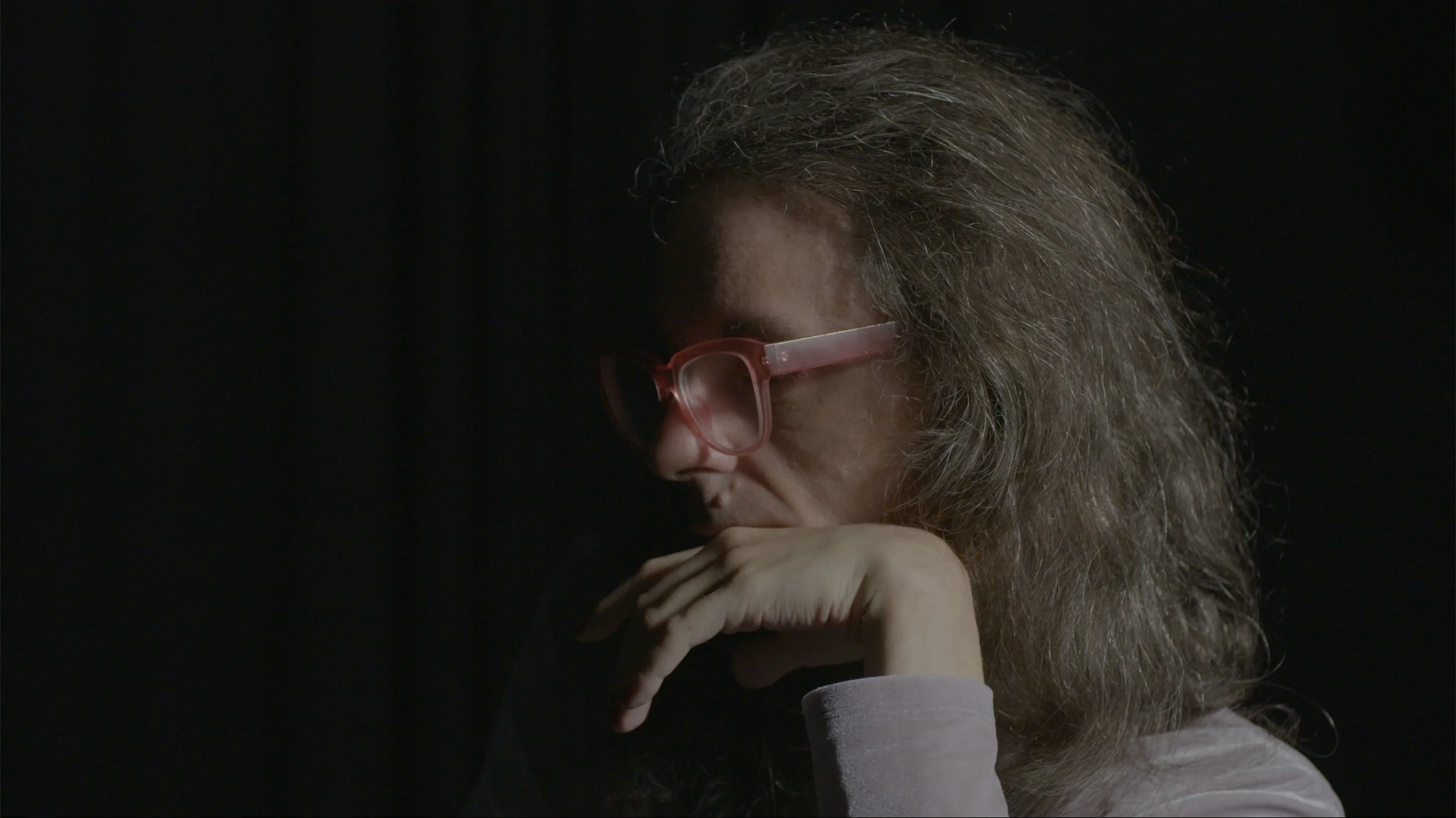
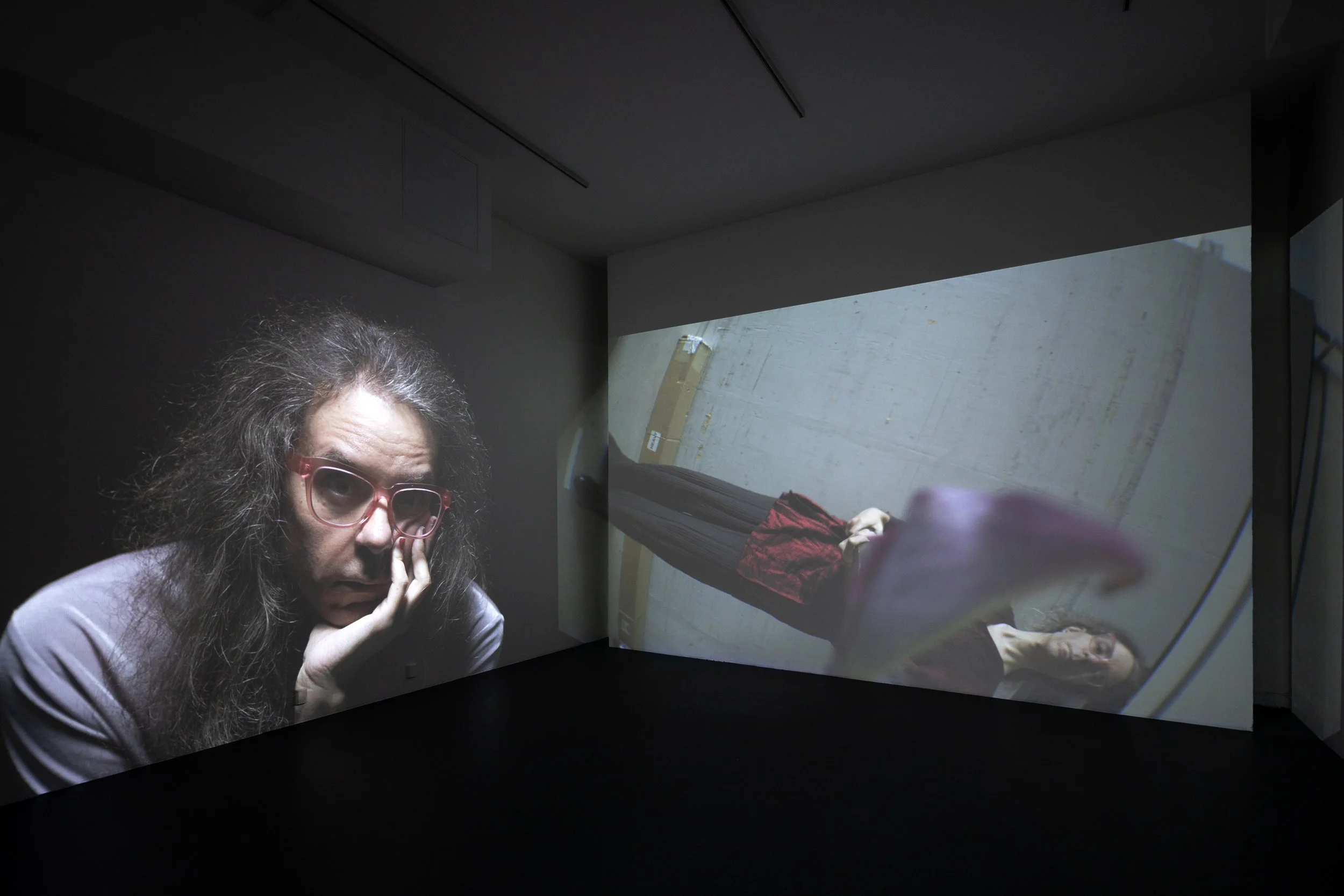
Portrait of a Poet (Taneli Viljanen)
One part in a suite of four 4K videos, shuffle play, endless duration
Lately, I have been particularly interested in portraiture as a form of dialogue. I suppose, as something inherently reciprocal and mirroring, that can potentially dissolve boundaries between self and other, but also, on the other hand, as a point of contact, where the very same boundaries can diverge, only to recede further apart. This multi-directional and fluctuating movement seems to interest me. My inquiries seem to be intrinsically tied to specific material questions, as well as to methodologies deeply rooted in the making of moving images.
How to destabilize a set of binaries so innate to portraiture? These ostensible divisions between subject and object, self and other, maker and subject, portraitist and sitter, or the gaze and its object. Can also the camera be approached dialogically? And how? So that it becomes a tool of exchange, that only heightens the unfixity of its subjects; allows images to be porous, elastic, uncontrolled, and thus, endlessly fluid. Could a camera, or lens based media in general, not freeze or capture? Or relinquish trying to find ”a soul”, ”a core”, ”an essence” or ”truth” about its subject, but rather acknowledge something else entirely, and not even function on the axis of empowerment/exploitation.
Even if I think my interest lies in the portrait in general, I find myself mostly looking at self-portraits made by other artists. I might be inclined to actually think all portraits are always, also self-portraits of sorts.
excerpt from a dialogue between Jani Ruscica and poet Taneli Viljanen
“… I made myself available to analysis. I gave them to believe that I, the clouds, could be reduced to a typology.
It was hard work. I had to replace the shapeless caprice of my atmospheres with 4 basic cloud types. I had to edit the indecipherably fluid filigree of my language into a dry-as-dust classificatory system replete with Latin terminology. And beyond that, I had to be flirtatious. If you bring a concept or category close enough to the human mind to be very very attractive and then whisk it away so it stays out of reach, it becomes erotic. Flirting is not in my nature but who would be bothered doing science if it weren’t erotic.
The 4 basic cloud types, as defined by amateur nephologist Mr. Luke Howard in a lecture at Plough Court in London on 10th December 1802, are: cirrus, cumulus, stratus and nimbus. Cirrus, from Latin for “lock of hair,” means a tendril or fibrous shape; cumulus from the Latin for “heap” or “pile” means a heap or pile; stratus from the Latin for “layer” means a horizontal band; and nimbus, Latin “cloud”, is a rainy combination of the 3 previous types. It was, let me repeat, hard work to dash about the universe impersonating these 4 cloud formations, not to mention the ceaseless transitions between them with their seductive lacy gaps…”
Anne Carson, Wrong Norma (2024)
documentation: Aukusti Heinonen, Jani Ruscica, exhibition views from ‘Jani Ruscica - Portrait of a poet’ Gallery Sculptor, Helsinki